

- April 15, 2026
- Staff Writer
- No Comments
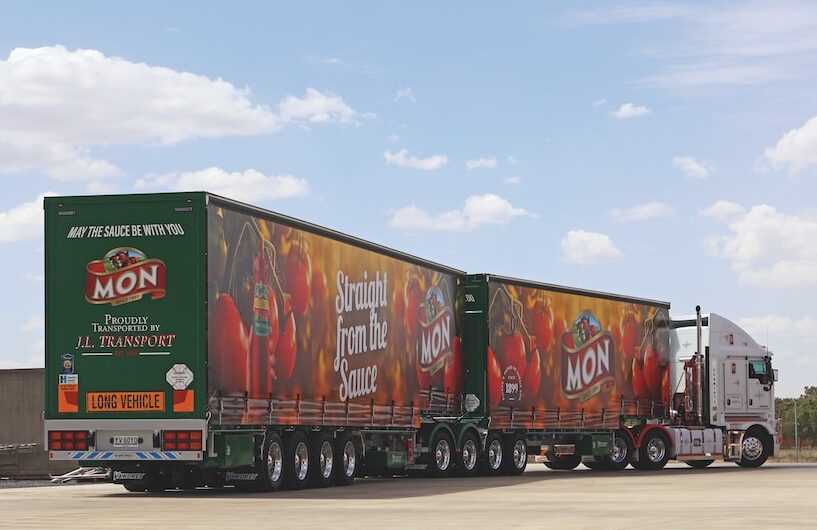
JL Transport adds to PBS fleet
Family-owned transport operators often measure success not only in kilometres travelled, but in the relationships built along the way. For JL Transport, those relationships extend from long-standing freight customers to equipment partners such as Vawdrey.
Victoria-based carrier, JL Transport, runs a national freight task across the eastern seaboard and beyond, but its story is grounded in a family business that has developed steadily over more than four decades.
Daniel Hellyer – JL Transport Assistant Manager and Workshop Manager as well as a third-generation member of the Hellyer family – says the company’s longevity has always been tied to its people.
“JL Transport is a family business with three generations currently involved,” he says. “Family involvement and dedication has definitely been a key to the stability of the business, but we are also blessed with a team that share the same values and many friendships built over the years.”
The company traces its origins to founder, John ‘Jack’ Hellyer, who established the modern version of the business in 1980 after taking over the operation from his father.
In the early days the focus was local cartage work, servicing the liquor industry around Victoria. But the company’s trajectory changed a decade later when key customers began expanding their distribution footprints.
“In 1990 the business evolved from local cartage to offering interstate services for Seppelts Wines and Greens Foods,” Daniel says.
This move marked a turning point. As customer networks grew, so too did the reach of the transport operation.
Rather than aggressively chasing volume, JL Transport expanded alongside its clients – a strategy that has resulted in unusually long business relationships. According to Daniel, one customer has been with the company for almost 38 years.
“We have a relatively small but long-term relationship with around 15 customers,” he says. “Our growth has been in line with theirs.”
The philosophy has been to maintain a personalised service model even as the freight footprint widened.
“Providing a personal service is still important in this industry and something we strongly believe in,” Daniel says.
For the Hellyer family, transport is part of everyday life. Daniel says the current generation grew up around trucks and depots, gradually finding their place in the operation. The experience has also provided a clear perspective on the realities of the industry.
“One lesson you learn early is that you are often remembered or judged by the one per cent of things that go wrong,” he says. “It’s a high-pressure, high-stress industry.”
Maintaining reliability in that environment depends on both people and equipment – something that has shaped the company’s approach to fleet investment. Today, JL Transport operates a fleet of approximately 80 trailers and 38 prime movers, supported by rigid trucks across the business.
The fleet undertakes a wide range of freight tasks including building materials, packaging, medical supplies, flooring products and frozen goods, as well as bulk food-grade liquids. That variety places specific demands on the trailer fleet.
“Our freight varies greatly in weight and dimension and even includes some dock hand loading,” Daniel says. “So, the trailer needs to suit different applications.”
Curtainsiders form the backbone of the fleet, including both straight deck and drop deck designs. The company also operates refrigerated vans, roll-back trailers and bulk liquid tankers.
Drop decks with mezzanine floors have been a particularly important configuration.
“Mezzanine floors are still our most common build because they offer the most flexibility,” Daniel says.
Over the past decade the company has increasingly focused on higher productivity vehicles through the Performance-Based Standards (PBS) scheme. Initially that meant adopting PBS-compliant designs across parts of the fleet.
More recently, JL Transport has begun expanding into the 30-metre high-productivity combinations as network access has improved.
“In the past decade we have started to move into PBS-type builds,” Daniel says. “In the last couple of years, we have extended that into the 30-metre space as routes became more accessible.”
Those developments led to the company’s most recent trailer investment with Vawdrey. The first delivery was a pair of 30-metre tri/tri Super B-double combinations now operating between Melbourne and Sydney.
According to Daniel, the trailers primarily carry lightweight freight but still offer significant payload capability.
“They are capable of carrying around 36 tonnes while providing at least 25 per cent more cubic capacity,” he says.
More recently JL Transport added a quad/quad 30-metre Super Double, running between Melbourne, regional New South Wales and Sydney. This unit is primarily tasked with food and packaging freight and can handle payloads of up to 42 tonnes, again delivering around 25 per cent more cubic capacity than conventional combinations.
Daniel says the decision to work with Vawdrey on these builds was influenced by the manufacturer’s experience with PBS equipment and the support it could provide through the development process.
“Recent purchases from Vawdrey were driven by a need to expand into that 30-metre PBS market,” he explains. “Their understanding of PBS builds and the support moving into that space was important.”
The relationship itself began through JL Transport Operations Manager, Scott Campbell, who had previous experience working with the manufacturer. Proximity also played a role, with Vawdrey’s operations located close to JL Transport’s depot in Melbourne’s south-east.
But the partnership extended beyond geography.
“Vawdrey kept us informed during the build process and provided updates along the way,” Daniel explains. “We were also able to visit the factory to make sure what was delivered was what we expected.”
For a fleet expected to remain in service for more than a decade, those levels of communication and aftersales support are critical.
“When you’re investing in trailers that we will most likely have for 10-plus years, you need to be sure the support will be there,” Daniel says.
The move into high-productivity combinations is also part of a broader strategy to improve operating efficiency.
“Our move into high-productivity trucks has been driven by the need to improve returns for our business and create savings for the customer,” Daniel says.
In an industry defined by tight margins and rising costs, modern trailer design can play an important role.
“It’s important to have an edge for survival in transport,” Daniel adds. “Keeping up with new products and efficiencies is essential.”
Driver feedback on the new equipment has been positive, reinforcing the value of the investment.
While JL Transport remains grounded in its family origins, it continues to adapt with the industry. Future plans include expanding the use of high-productivity vehicles where network access allows.
“At this stage we are working towards more high productivity builds where we can benefit customers and our own business going forward,” Daniel says.
The approach reflects a philosophy that has guided the company since its earliest days – grow alongside customers, invest carefully in equipment and maintain strong partnerships.
For a business now spanning three generations, that formula continues to deliver results on Australia’s freight corridors.
